
Breeding notebook / PC full release — November 2026
Choose parents for 50/50, 75/75 and 100/100 foal potential
Choose a pair that can reach your target in both strength potential and endurance potential. A high strength sire can still leave endurance too low. The launch guide by Walkthrough Forge reports a separate roll for each stat: the parents’ average plus −4 to +11 for unrelated parents, before Inheritance modifiers and stat limits. The examples below apply that reported rule to invented parent values; they are planning examples, not observed foals.
Updated 2026-11-06 · PC full release — November 2026
The decision, step by step
Record potential, not today’s trained values
For each prospective parent, record strength potential, endurance potential, known Inheritance traits and the relationship between the pair. A displayed potential interval is an estimate; the vet’s Test Potential costs 150 coins and reveals the exact values. Test hidden traits separately if they could change an expensive breeding decision.
Compare the weaker side of each pairing
Example goal: a foal with at least 50 potential in both stats. The mare has exact potential 60 strength / 50 endurance. Both candidate stallions are unrelated to her, and no Good or Bad Inheritance applies. Prefer stallion B: its lower strength result is already sufficient and its endurance is substantially safer.
More columns → Scroll sideways, or focus the table and use arrow keys.
Illustrative parent comparison — exact potential, no Inheritance modifiers Pair with mare 60 / 50 Parent averages S / E Reported foal ranges S / E Decision for 50/50 Stallion A: 90 / 30 75 / 40 71–86 / 36–51 Endurance reaches 50 only near its top; strength is surplus Stallion B: 60 / 70 60 / 60 56–71 / 56–71 Both lower bounds exceed 50; default choice for this goal Match the pair to the next milestone
These examples use two unrelated parents with the same exact potential in both stats and no Inheritance modifiers. The 100 limit caps a high roll. Reaching a target in one stat does not complete a goal that asks for both.
More columns → Scroll sideways, or focus the table and use arrow keys.
What equal-potential parents can produce under the reported launch rule Each parent S / E Foal range in each stat Goal this supports 40 / 40 36–51 50/50 is possible; most of the range is below 50 55 / 55 51–66 50/50 is above both lower bounds 65 / 65 61–76 75/75 is possible near both upper ends 80 / 80 76–91 75/75 is above both lower bounds 90 / 90 86–100 100/100 is possible, not guaranteed 100 / 100 96–100 Even capped parents do not guarantee 100/100 Recheck relatedness and Inheritance
For each stat, the reported bonus range is −4…+11 for unrelated parents, −8…+7 for half-siblings or a grandparent–grandchild pair, and −12…+3 for full siblings or parent–child. Each Good Inheritance parent shifts the range up by 2; each Bad Inheritance parent shifts it down by 2. These changes can invalidate the safe lower bounds in the examples. Prefer an unrelated sire when potential is the priority. Reported stat limits are 25–100 for strength potential and 20–100 for endurance potential.
Confirm the pairing in the Lab if available
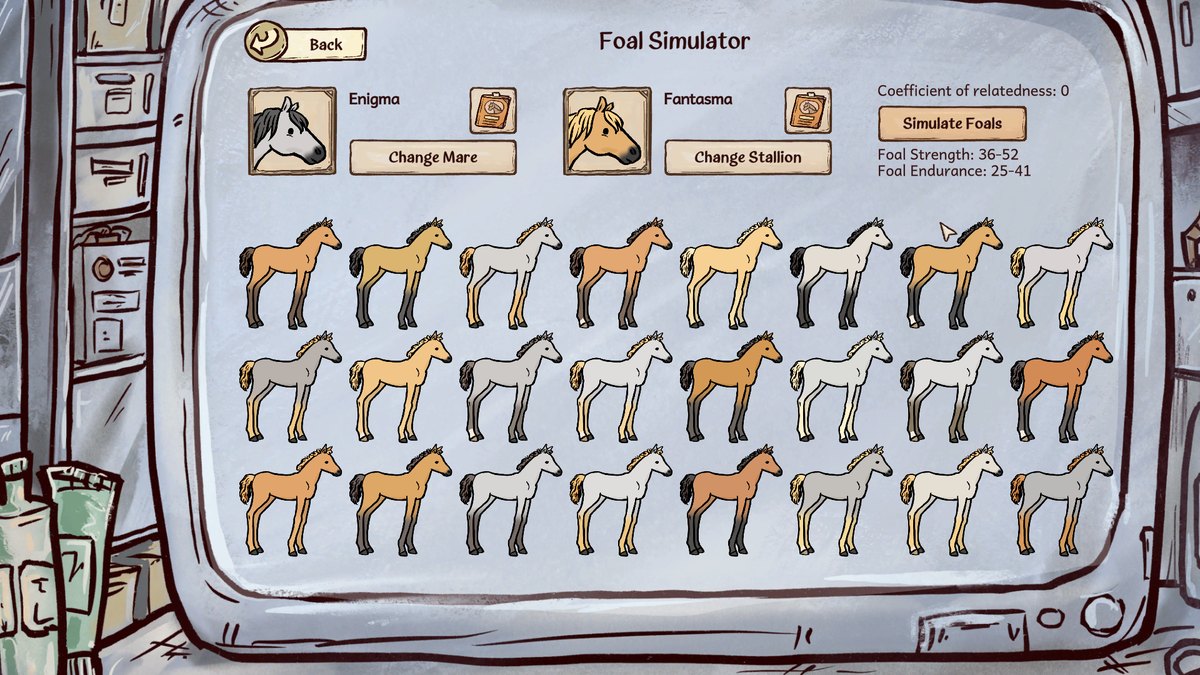
Breeding Station stage 2 opens the Lab. Select the exact mare and sire in Foal Simulator and read both ranges plus the coefficient of relatedness. The screenshot is one existing pair, not the invented comparison above. A preview can omit hidden Inheritance traits, and its printed upper bound is reported as one point higher than an actual roll.
 Open full-size image ↗
The selected pair’s readout: relatedness 0, strength 36–52 and endurance 25–41. Open the original to see both parent selectors. Keep the foal that advances your actual goal
After birth, evaluate both potential stats rather than the foal’s starting training. If the next threshold is still out of reach, keep useful improvements and look for another unrelated partner. Do not schedule a guaranteed number of generations: rolls, sire availability and raising each foal all affect progress.
What success looks like
You can name the chosen pair, state the range in each stat and explain whether the target is only possible or already below both lower bounds under the stated assumptions. Verify the born foal’s potential against the goal.
If the result is different
If one stat cannot reach the target, change the parent contributing the weak stat. If results are worse than the preview suggests, recheck hidden Inheritance, actual rather than estimated potential, relatedness and the preview’s upper endpoint. Training a parent’s current stats will not repair a potential mismatch.
Sources & game version
For the PC full game. Screens and community observations can differ after updates; an exact client build is not shown in the published screenshots.